

What Is Immigration? Meaning, Types, Process & More
What is immigration, and why is it so complex when you google it for the first time? Well, to put it simply, it is relocating from one country to another, either temporarily or permanently. Words like visa, PR and sponsorship may be difficult to comprehend at this point; but worry not, because this guide will answer all your doubts using simple language that even an expert over a cup of tea would use.
We have written this guide keeping in mind the most common doubts of newbies, and we have cross-checked all information from the official websites of governments.
What Is Immigration? A Simple Definition
Immigration is the process whereby an individual relocates to another country with the aim of settling either temporarily or permanently. In most cases, one has to be authorized legally before he or she can migrate, for example, having a visa or a resident permit. Consider this simple illustration. When an individual migrates from India to Canada for employment and settlement purposes, then he or she will be considered an immigrant in Canada but an emigrant from India.
Therefore, what exactly is immigration? It encompasses everything: selecting the right country, assessing your eligibility, applying, and settling there. Immigration is distinct from tourism in that a tourist comes on holiday but migrates back whereas an immigrant spends more time studying or working in the foreign country.
Immigration vs Emigration vs Migration
| Term | Meaning | Example |
| Immigration | Entering a new country to live there | An Indian student settling in Australia |
| Emigration | Leaving your home country to live elsewhere | The same student leaving India |
| Migration | Any movement of people, inside or across borders | Moving from a village to a city |
| Expatriate | Someone living abroad, usually for work and often for a limited time | A manager posted overseas for a few years |
Why Do People Choose to Immigrate?
Everyone has his or her own story, but motivations can be divided into the following categories:
- Professional advancement: increased wages, professional requirements and worldwide experience
- Educational: world-famous educational institutions and scientific laboratories
- Family reunification: joining spouse, parent, or child living in another country
- Standard of living: health care, security, environment and social security
- Business: establishing business ventures or investments in other countries
- Safety: escape from persecution or war through refugee/asylum programs
Main Types of Immigration
Understanding what is immigration also means knowing that it comes in different forms. Your goal decides which one fits you.
| Type | Length of Stay | Who It Suits | Common Example |
| Temporary | Fixed period | Students, workers, visitors | Study visa, work permit |
| Permanent | Long term | Skilled professionals, settlers | Permanent residency (PR) |
| Family-based | Depends on the sponsor’s status | Spouses, children, parents | Spouse sponsorship, dependent visa |
| Humanitarian | Based on protection needs | Refugees, asylum seekers | Refugee status |
| Business/investor | Medium to long term | Entrepreneurs, investors | Startup or investor visa |
Many other countries have points-based systems for immigration of skilled persons. Here your age, education, work experience, and language abilities will earn you some points. The other very common way of immigration is the Study to Work path, which includes studying in the foreign country and working under a post-study work permit.
Visa vs PR vs Citizenship: What Is the Difference?
Beginners often mix these three up. This table clears it in seconds.
| Feature | Visa | Permanent Residency | Citizenship |
| Purpose | Short-term permission | Long-term right to live | Full membership of the country |
| Duration | Fixed period | Long term, card needs renewal | Permanent |
| Right to work | Depends on visa type | Generally yes | Yes |
| Right to vote | No | Usually no | Yes |
| Local passport | No | No | Yes |
- Most individuals gradually proceed to get their visa, PR, and finally citizenship, although not all desire this.
- How does the immigration process work?
- Although it differs per nation, the process can be outlined in the following manner:
- Decide your goal. Find out if you want to study, work, be with your family, or immigrate.
- Research countries and programs. Compare your qualifications against the requirements.
- Check your qualifications. Consider your age, education, and profession, language proficiency, and financial status.
- Take the tests. You have to undertake a language test and a credential assessment test for most programs.
- Prepare all your documents. Ensure that you maintain originals and copies.
- Submit applications formally. Fill out the applications and pay the government processing fees.
- Take the biometric and medical tests whenever needed.
- Finally, plan for the relocation process.
Documents You Usually Need
In most cases, you will need the following documentation: a valid passport, educational certificates, work experience certificates, exam certificates, financial proof, police certificates, a medical certificate, and photographs. For family applications, marriage and birth certificates are also needed. It is worth noting that the list may vary from one country to another, so you should consult the list on the official website of the particular embassy or consulate.
What Do Immigration Officers Look At?
Officer will be interested to know that you meet the requirements, are able to support yourself, and pose no threat to Canada. Typically, an applicant is screened for age, education, work experience, language skills, finances, health, and good character. Having an offer of employment helps most applications, but not a few skilled worker programs.
Cost and Timeline: What to Expect
This expense is typically made up of government costs, language tests, credentials verification, physical examination, document translation, travel, and your initial period of settlement. While some visa applications for visitors can be made in a few days or weeks, PR applications tend to take a long time to process. Government fees and processing time tend to be updated regularly, so you should always refer to the latest fees page.
Immigration at a Glance: The Global Picture
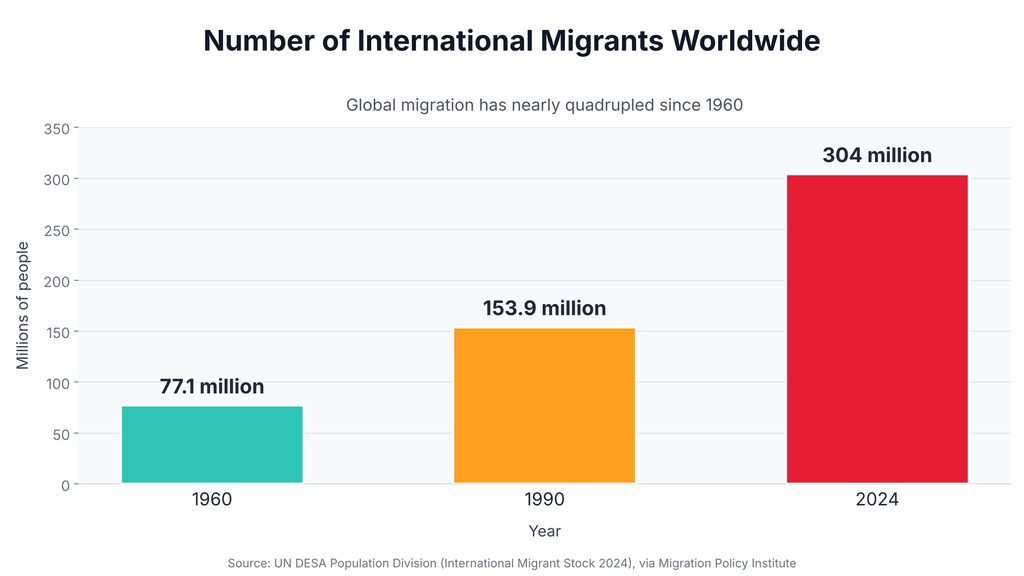
[ Graph shown above here. Alt text: “Bar chart showing international migrants worldwide rising from 77.1 million in 1960 to 153.9 million in 1990 and 304 million in 2024.” Caption: “Source: UN DESA Population Division, via Migration Policy Institute.”]
The graph shows that international migration has nearly quadrupled since 1960. In other words, immigration is not rare. It is a normal path millions of families have taken, and with the right preparation, you can take it too.
Common Mistakes and Scam Warning Signs
Some of the most common mistakes include using out-of-date data, not providing necessary documents, forging (and this may result in being banned for longer time, missing the deadlines, and applying too soon before you prove your eligibility. It is important to avoid dealing with those individuals who promise you everything regarding a visa, ask you for full payment without any contract, have no registered address and persuade you to act quickly.
Should You Hire a Consultant or Apply on Your Own?
In cases where you have a straightforward profile and are good at paperwork, you may opt to apply all by yourself. In instances where your profile is complicated, where you do not know what kind of pathway suits you best, or you wish to avoid errors in your application process, you could employ a reliable consultant to assist you with assessing your profile, preparing and reviewing your application.
Canviza is one such consultant who will work with you right from the start and guide you with straightforward advice. In cases where you would like to assess what your prospects are without having to pay any fees or take any tests at all, then you can make use of Canviza’s services to assess your profile.
Conclusion
Once you understand what immigration is all about, everything else will fall into place for you. All you have to do is follow a systematic process that starts with defining your objectives, assessing your eligibility, selecting the right channel, and applying after preparing yourself. Be systematic when following the process but be careful about your sources, and ensure that your financials are in order. For professional evaluation of your profile, Canviza is prepared to guide you through this process.
Frequently Asked Question
There are four main types of immigration – temporary, permanent, family and humanitarian & investment immigration. You can determine your appropriate type of immigration from the purpose of your immigration and your background.
Yes. It is widely classified into temporary, permanent, family based and humanitarian immigration. Some sources consider business and investor routes as a separate fifth one.
It refers to relocating from one’s native country to another for living there either temporarily or permanently, with the permission to do so (visa or permit).
There is not a specific five stage process that applies to everyone, but here it can be said that the process involves setting a goal, checking eligibility, preparing all the required documents and making the application, then waiting for the result and finally settling down.
Not really. Emigration is the process of leaving one’s own country, whereas immigration refers to the process of going to another country. They are the same processes, only seen from different perspectives.
“Emigrate from” is used for the country you leave and “immigrate to” is used for the country you move into. You emigrate from India and immigrate to Canada.
Immigration is the process of settling in another country with the aim of making such a country your home for some time or forever.
Migration is usually classified according to whether it is internal, international, voluntary and forced.
Canviza can analyze your age, education, work experience and objectives; provide information on possible ways for you to become an immigrant; and offer you documents that would prevent you from committing common errors.